
Connecting SAP Cloud ERP to your existing customer relationship management software, banking systems, or supply chain tools does not have to compromise your security or break future upgrades. By leveraging the SAP Integration Suite, you can establish clean, stable connections while maintaining a standard core.
FREE DemoBOOK A CONSULTATION




Core Capabilities of the SAP Integration Suite for SAP Cloud ERP
The SAP Integration Suite achieves seamless connectivity by deploying a specialised set of modular capabilities designed to address distinct integration challenges. Rather than relying on rigid custom coding, this powerful suite utilises a combination of preconfigured connectors, automated application programming interfaces, and asynchronous communication models. These core features work together to streamline how your business systems share information, process transactions, and maintain absolute security.
At Leverage Technologies we appreciate integrations are critical but also complex, so please contact us and we can talk about your individual use case.
Cloud Integration
This acts as the primary, enterprise-grade process integration engine within the platform, enabling developers to visually design, deploy, and monitor complex integration flows (iFlows) across hybrid cloud environments. It handles heavy-duty data transformation, schema mapping, and message routing between disparate databases and systems. By utilising SAP’s vast library of prebuilt integration content, business analysts can dramatically accelerate deployment times, automate cross-application business processes, and reduce the technical debt typically associated with custom middleware development.
API Management
This critical component provides a comprehensive API gateway, life cycle management console, and customizable developer portal designed to securely expose, protect, and monitor application programming interfaces across both SAP and non-SAP environments. It safeguards your digital assets by handling essential runtime security tasks, including XML threat protection, OAuth 2.0 authentication, rate limiting, traffic throttling, and detailed analytics routing. This ensures that external developers and internal systems can interact with your core ERP data securely without degrading system performance.
Open Connectors
This specialised capability accelerates third-party integration by offering instant access to hundreds of prebuilt, fully managed connectors for popular non-SAP cloud applications, including CRM, HR, and collaboration tools like Workday, ServiceNow, and HubSpot. By normalising authentication, request-response structures, and error handling into a single, unified developer experience, it eliminates the need to write and maintain complex, custom API adapters, thereby lowering the total cost of ownership for multi-vendor software ecosystems.
Event Mesh
Designed to support highly scalable, asynchronous, event-driven architecture, this fully managed service enables applications to communicate in real time through light-weight event messages. Instead of demanding constant, resource-intensive API polling from external systems, a change inside your ERP (such as a drop in inventory levels, a new customer record, or a generated invoice) instantly publishes an event. Any subscribed application can react to this message immediately, optimising network bandwidth and ensuring data synchronisation across your enterprise network.
Integration Advisor
Operating as an artificial intelligence and machine learning-driven capability, this tool is specifically engineered to streamline complex data mapping and interface definition. It intelligently analyses standard industry document schemas (such as EDIFACT, ASC X12, and XML) and automatically generates context-specific mapping recommendations and comprehensive documentation. This machine-guided approach eliminates manual configuration errors, simplifies partner onboarding, and slashes the time required to design and test custom business-to-business (B2B) integrations.
SAP Cloud ERP Product Tour and Interface Walkthrough
Experience the power of a modern cloud platform through our comprehensive visual demonstration video. This interactive overview showcases the intuitive user interface, customisable role based dashboards, and fluid navigation pathways that define the modern SAP user experience. See firsthand how your teams can easily manage complex multi company data, review real time operational analytics, and execute high volume financial transactions within a single unified workspace. Our platform tour highlights how embedded AI capabilities like Joule and advanced system automation simplify everyday workflows, giving your leadership team complete visibility to drive business efficiency and mid-market growth.
Are there limits on API calls or integration volume?
Yes – like any cloud platform, SAP meters integration traffic, and very high-volume connections need to be designed with that in mind. For normal business use it is rarely an issue. The usage is also visible, which is the part that matters. You can monitor API and integration consumption in SAP Cloud ALM and in the SAP BTP cockpit, so you see how much you are using and can act before you reach a limit rather than after. That keeps you ahead of it instead of meeting a nasty surprise on a bill or a connection that suddenly throttles. We design integrations to be efficient, set this monitoring up with you, and flag any high-volume scenario early so it is planned for rather than discovered later. One thing worth checking before you buy: some SAP bundles include BTP credits that can offset consumption on this side, so confirm what your agreement already covers rather than paying for it twice.
Looking for a quote on SAP Cloud ERP?
About SAP Cloud ERP
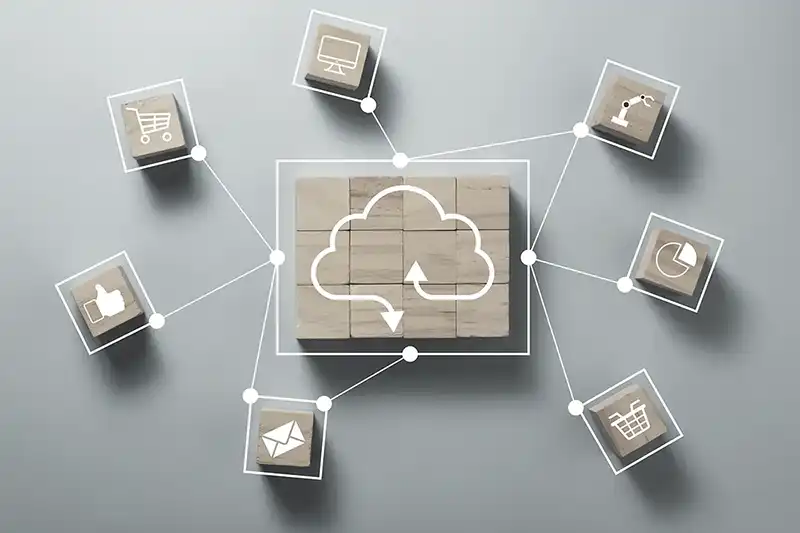
Welcome to SAP Cloud ERP, the smart, cutting-edge ERP system that enables companies of all sizes to operate in the cloud. You can revolutionise your business operations and enhance decision-making with real-time analytics, automation, and collaboration with SAP Cloud ERP, a cutting-edge digital platform. SAP Cloud ERP has the power and flexibility to match your business objectives, whether you’re wanting to improve customer experience, streamline operations, or spur innovation.
Industries for SAP Cloud ERP
SAP Cloud ERP is designed to deliver rapid time-to-value across industry-specific operations through preconfigured best-practice processes. Built on the foundation of SAP Cloud ERP, it provides ready-to-run capabilities across finance, sales, procurement, manufacturing, supply chain, and project management. These embedded workflows reduce implementation complexity, accelerate deployment, and enable mid-market organisations to scale with confidence while maintaining operational control and compliance.
If you don’t see your industry listed above, give us a call on 1300 045 046 or email the Leverage team [email protected]. SAP Cloud ERP has additional industry sectors and lines of business available. The expert SAP team at Leverage Technologies will be happy to assist with additional information specific to your industry.

How does SAP Cloud ERP connect to our existing systems?
Through SAP Integration Suite on SAP Business Technology Platform. It comes with a large library of prebuilt connectors to common applications, banks, tax engines and standards, so most connections are configuration rather than custom code. Where something bespoke is needed, it is built on open APIs on the platform, not inside the core system.
Can we build custom integrations without breaking SAP Cloud ERP?
Yes, and it helps to separate two things people often lump together. Extensibility is how you change what the system does for you, through extra fields, custom forms, your own logic or a purpose-built app. Integration is how SAP Cloud ERP talks to other systems, such as your bank, CRM or freight platform. The principle behind both is the same. Smaller changes use in-app extensibility inside the system, anything larger is built as a side-by-side extension on SAP Business Technology Platform, and integrations run through SAP Integration Suite on that same platform. None of it cuts into the core, which is what keeps the twice-yearly updates safe.
Before each release lands, SAP’s Release Assessment and Scope Dependency tool (RASD) compares what is changing in that update against how your system is actually configured and used. It gives a day-one view of exactly what the release touches, so we know where to focus regression testing and which business roles and apps to check rather than testing everything blind. That turns each upgrade into a planned, contained piece of work. It is the opposite of the heavily customised on-premise systems that became so expensive to upgrade.
Modernise Your Business – Moving from On-Premise Legacy Systems to SAP Cloud ERP
SAP Cloud ERP is built for organisations looking to quickly and with lower risk move away from ageing, infrastructure-heavy systems. It offers preconfigured best-practice processes and guided implementation to accelerate deployment, reduce total cost of ownership, and enable a smooth transition to a secure, scalable cloud platform.
Discover the Impact of SAP Cloud ERP
SAP Cloud ERP empowers mid-market businesses to modernise operations, drive innovation, and deliver better customer experiences. Explore these helpful resources:
More SAP Cloud ERP Questions?
More questions about SAP Cloud ERP? Call 1300 045 046 or Contact Us to get the answers you are looking for.
How is our business data secured, and can it be hosted locally in Australia?
Your data is hosted in world-class enterprise data centres managed directly by SAP, which completely removes the day-to-day burden of infrastructure patching, vulnerability monitoring, and physical security from your internal IT team. SAP protects your business assets using rigorous encryption standards, including AES-256 encryption at rest for the underlying SAP HANA database and storage layers, alongside TLS encryption for all data in transit. Although the platform runs on a modern multi-tenant architecture, your specific environment remains logically and completely isolated from all other customers at both the application and database levels, ensuring your data never sits in a shared pool.
For Australian businesses, data residency is a critical compliance consideration. By default, the SAP Cloud ERP Public Edition is hosted within SAP’s Asia-Pacific region, which is physically located in Singapore. However, if your industry regulations or internal policies strictly mandate that data must remain in-country, we can deploy SAP Cloud ERP Private Edition on hyperscaler regions located directly within Australia.
Because the ideal hosting setup depends entirely on your specific contract and operational requirements, we map out these exact residency and deployment arrangements early in the discovery phase. If you need to verify hosting locations or discuss cloud requirements for your business, contact our team today to map out the right deployment architecture for your organisation.
Don’t take our word for it
Read More MYOB Acumatica Reviews

About Leverage Technologies
Your SAP Cloud ERP Partner
As gold ERP implementation partner for SAP Cloud ERP, Leverage Technologies has extensive experience delivering AI, consulting, implementation, and ongoing support for businesses across multiple industries.
Looking for a trusted SAP implementation partner with deep local knowledge?
- Offices in Sydney, Melbourne, and Brisbane
- AI powered solutions and consultancy
- 50+ in-house ERP consultants
- 20 years of delivering ERP solutions
- Over 450 Australian businesses served
- Accredited SAP Gold Partner
Questions we get asked about SAP Cloud ERP Integrations
What independent security certifications and identity controls does SAP Cloud ERP support?
SAP Cloud ERP is backed by a comprehensive matrix of independent, third-party audit reports and compliance certifications. This includes standard information security frameworks like SOC 1, SOC 2, and ISO 27001, as well as the specialised ISO 42001 standard for responsible AI management. This AI-specific compliance is particularly crucial as your business begins leveraging Joule, SAP’s built-in digital assistant. Every single compliance commitment is formally written into your service level agreement, the SAP data processing agreement, and global support policies, ensuring your security assurances are contractually guaranteed.
To maintain absolute control over who accesses this system, user identity remains fully in your hands. Users access their dedicated, unique URL using single sign-on (SSO) authenticated via SAML 2.0 through your existing identity provider, eliminating the risk of weak or duplicated passwords. Access is strictly managed through role-based permissions, and these exact same boundaries apply to AI interactions. Joule works natively within each user’s assigned permissions, meaning the AI will never surface sensitive financial or payroll data to an unauthorised employee.
While SAP manages the infrastructure, we work closely with you to design robust internal governance workflows, such as user provisioning and offboarding controls, from day one. To help your IT, risk, and compliance teams with their due diligence, reach out to our consulting team today to request the latest formal audit reports and security documentation for your review.
Who maintains our integrations after go-live?
That is something we settle before go-live, not after. Connected systems change and their APIs get updated, so each integration needs an owner who keeps it working. We agree clearly which links we maintain and which sit with you or another vendor, so nothing falls through the gap.
What certifications and compliance standards does SAP hold?
SAP maintains a broad set of independent security and operational certifications and audit reports, the kind your risk and audit teams will ask to see, and that now includes ISO 42001 for responsible AI management. The commitments are backed contractually through the service level agreement, the SAP data processing agreement and the support policy. We provide the current documentation as part of the security conversation, so your people have what they need to sign off.
How do users sign in, and how is access controlled?
Each customer reaches the system on its own dedicated URL, and standard users sign in through single sign-on using SAML 2.0 via SAP Cloud Identity, so people authenticate through your existing controls. Access is role-based, so each person only sees what their role allows, and the AI works inside those same permissions rather than around them.
Get in Touch
Want to know more about SAP Cloud ERP? Contact the SAP Cloud ERP team at Leverage Technologies on