
Evaluating Your SAP Cloud ERP Investment: A Transparent Breakdown of True Software and Scoping Costs
FREE DemoBOOK A CONSULTATION




What Are the Estimated Implementation for Costs for SAP Cloud ERP?
Pricing information about user type and licensing is further down the page – this table is strictly outlining the potential implementation cost
Upgrading your core business software requires a clear and predictable budget. SAP Cloud ERP offers a highly flexible software subscription model built specifically for growing Australian businesses, matching your ongoing costs directly to your specific modules, user numbers, and chosen cloud setup. This modern approach means you only invest in the exact capabilities your organization needs to succeed.
The matrix below outlines our baseline project estimates to help your team map out a clear total cost of ownership without unexpected surprises down the track. Your final investment path depends entirely on the specific lines of business you choose to activate and your exact internal user mix, which our team confirms following a structured upfront scoping workshop.
| Core Functional Footprint | Low Complexity / Small Scale | Medium Complexity / Medium Scale | High Complexity / Large Scale |
| Finance Only |
$77,000+ |
$110,000+ |
$180,000+ |
| Finance and Distribution |
$95,000+ |
$160,000+ |
$240,000+ |
| Finance, Distribution, and Manufacturing |
$130,000+ |
$220,000+ |
$320,000+ |
Note: Baseline annual software licensing for SAP Cloud ERP standard packages typically starts from around $77,000 AUD annually depending on your specific user count and functional requirements.
Interested in SAP Cloud ERP?
SAP Cloud ERP Product Tour and Interface Walkthrough
Experience the power of a modern cloud platform through our comprehensive visual demonstration video. This interactive overview showcases the intuitive user interface, customisable role based dashboards, and fluid navigation pathways that define the modern SAP user experience. See firsthand how your teams can easily manage complex multi company data, review real time operational analytics, and execute high volume financial transactions within a single unified workspace. Our platform tour highlights how embedded AI capabilities like Joule and advanced system automation simplify everyday workflows, giving your leadership team complete visibility to drive business efficiency and mid-market growth.
Cost Control Pillars of an SAP Cloud ERP Deployment:
01
Securing Core Cloud Software Licensing
Align your capital directly to business outcomes by securing a flexible SaaS subscription framework tailored to your required functional footprint and organisational complexity. This foundational software investment ensures your business gains access to purpose built enterprise resource planning environments such as the Public or Private Editions while providing a clear framework of full and light user types designed to keep ongoing costs predictable as your operation grows.
02
Deploying Professional Implementation Consultancy
Partner with an SAP Gold Partner and certified integration experts who properly configure the core cloud platform to match your specific functional requirements. Investing heavily upfront in a structured scoping engagement and data migration validation eliminates unexpected variations after signing contracts, reduces transition risks, and accelerates your overall time to value through established deployment frameworks like GROW with SAP.
03
Committing Ongoing Support and Client Services
Protect your long term operating expenses and maintain complete operational continuity post go live with a structured ongoing support partnership. This crucial service pillar focuses on building internal business capability through intensive initial hypercare support, managing critical twice yearly automated system updates seamlessly, and establishing self sufficiency for your internal super users as you scale.
04
Allocating Internal Project Governance Resources
Recognise that a successful enterprise transformation requires dedicated internal resource allocation to support the implementation team. Assigning a dedicated internal project manager to orchestrate tasks and releasing core subject matter experts from day to day duties to handle master data conversion and user acceptance testing reduces external consultant dependency and ensures absolute boardroom signoff confidence.
Primary Strategic Cost Drivers of a SAP Cloud ERP Implementation
Every mid-market enterprise possesses a unique operating footprint, meaning that no two deployments of SAP require the exact same professional services effort. While baseline software licensing remains highly predictable, the initial consultancy investment scales based on specific operational complexities within your business.
To provide complete commercial transparency and help your leadership team avoid unexpected budget overruns, we map out the specific technical variables that influence the overall configuration scope. Understanding these drivers allows your executive board to make informed strategic decisions that protect your capital allocation and accelerate project delivery timeframes.
Functional Scope and Complexity
The number of operational modules deployed alongside your specific business rules forms the foundation of project pricing. Standard financial ledger configurations within SAP Cloud ERP require a highly predictable baseline investment, whereas layering advanced capabilities like SAP Business Technology Platform features, specialised supply chain management, or autonomous SAP Joule AI agents increases configuration and system testing timeframes.
Fit to Standard Approach
Adopting preconfigured processes determines how closely your business aligns with established SAP industry best practices. Utilising the standardised GROW with SAP Fast framework minimizes implementation costs by keeping modifications low, while requesting complex workarounds or unique deviations from standard SAP processes increases consultancy hours and extends testing cycles.
Integration Landscape
The cost of connecting your core digital core to existing legacy tools depends on the number and nature of system connections. Connecting native SAP environments is highly straightforward, whereas linking third party legacy platforms, proprietary databases, or external customer portals to your SAP Cloud ERP digital core requires custom API engineering and rigorous validation protocols to ensure smooth data flows.
Data Readiness
The quality, structure, and cleanliness of your legacy records before migration heavily impact project timelines. Arriving with clean, extracted master data ready for the SAP migration cockpit significantly lowers the consultancy delivery fee, whereas relying on implementation partners to handle extensive data cleansing, deduplication, and complex mapping transformations adds time and expense to the SAP deployment.
Customer Resourcing and Engagement
The availability and dedication of your internal team directly affect the efficiency of the deployment. Appointing a dedicated project manager and liberating subject matter experts from daily workloads allows SAP workshops and user acceptance testing to proceed seamlessly, preventing the costly project delays that occur when internal roles are not backfilled.
Looking for a quote on SAP Cloud ERP?

About SAP Cloud ERP
Welcome to SAP Cloud ERP, the smart, cutting-edge ERP system that enables companies of all sizes to operate in the cloud. You can revolutionise your business operations and enhance decision-making with real-time analytics, automation, and collaboration with SAP Cloud ERP, a cutting-edge digital platform. SAP Cloud ERP has the power and flexibility to match your business objectives, whether you’re wanting to improve customer experience, streamline operations, or spur innovation.
How to Align Your Staff Roles to the Right User License Type to Avoid Wasted Expenditure
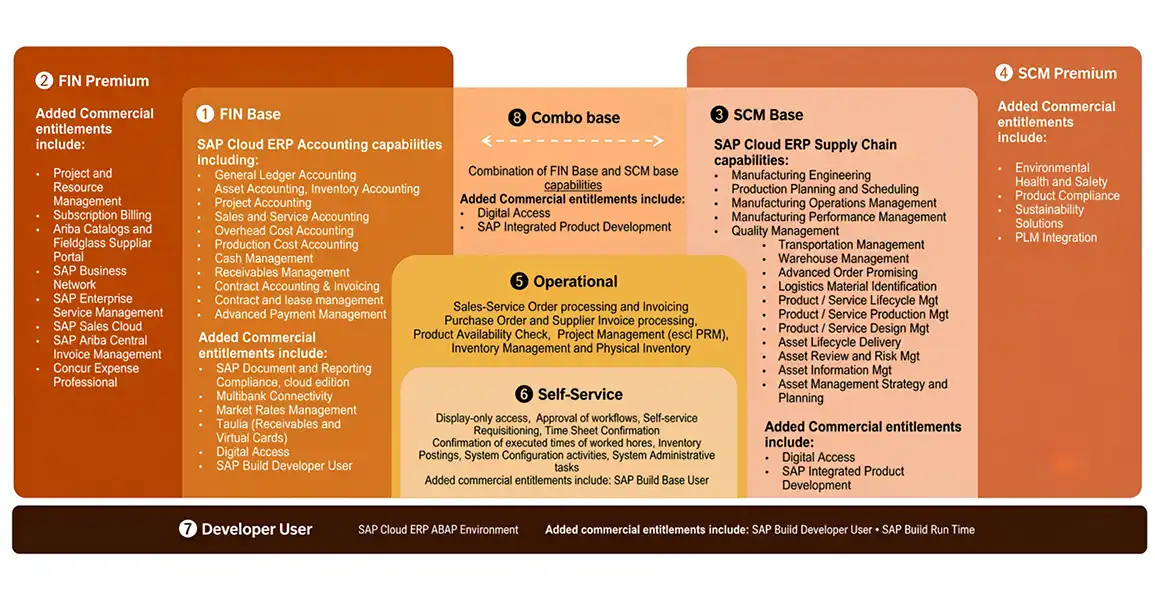
Optimising your ERP investment requires moving away from traditional, flat-rate software licensing and embracing a precise, role-based strategy. Modern cloud deployments utilise a structured Named User model where higher-tier licences automatically inherit the capabilities of the tiers beneath them, meaning that placing a staff member on an unnecessarily elevated tier directly impacts your bottom line. By carefully evaluating the specific daily activities of your workforce rather than relying solely on corporate titles, your business can systematically map each team member to their exact functional requirement, completely eliminating unnecessary operational overhead.
As shown in the image, the licensing architecture scales from foundational tiers up to specialised streams. Entry-level tiers like Self-Service and Operational are perfect for staff handling general administrative tasks or standard transactional order processing, while core department specialists utilise dedicated FIN Base or SCM Base paths (or a hybrid Combo Base for cross-functional roles). At the peak of the framework sit the Premium licences, which add advanced commercial entitlements like subscription billing or sustainability solutions; reserving these premium tiers strictly for executive leadership ensures you only pay for the exact capabilities your staff utilise.
Are there extra licensing fees or hidden consumption charges to utilise the built in AI?

Potentially – the split between baseline automation and advanced intelligence is highly transparent within the modern SAP ecosystem. SAP structures its artificial intelligence capabilities into two distinct operational tiers, ensuring your business only pays for the exact level of sophistication your team requires. The foundational layer, known as Joule Base, is fully embedded within your standard monthly SAP Cloud ERP software subscription at no extra cost. This native architecture handles conversational navigation, basic search inquiries, and standard data retrieval tasks. By utilising Joule Base across your entire workforce, your finance department avoids purchasing expensive third party software plugins or managing unexpected transaction fees for everyday informational requests.
For mid-market organisations looking to scale operational efficiency further, advanced transactional features, autonomous multi agent automations, and deep business process optimisations require an upgrade to Joule Premium. This advanced tier is not billed as a rigid per seat license; instead, it is funded via a flexible pool of SAP AI Units.
Industries for SAP Cloud ERP
SAP Cloud ERP is designed to deliver rapid time-to-value across industry-specific operations through preconfigured best-practice processes. Built on the foundation of SAP Cloud ERP, it provides ready-to-run capabilities across finance, sales, procurement, manufacturing, supply chain, and project management. These embedded workflows reduce implementation complexity, accelerate deployment, and enable mid-market organisations to scale with confidence while maintaining operational control and compliance.
If you don’t see your industry listed above, give us a call on 1300 045 046 or email the Leverage team [email protected]. SAP Cloud ERP has additional industry sectors and lines of business available. The expert SAP team at Leverage Technologies will be happy to assist with additional information specific to your industry.
Modernise Your Business – Moving from On-Premise Legacy Systems to SAP Cloud ERP
SAP Cloud ERP is built for organisations looking to quickly and with lower risk move away from ageing, infrastructure-heavy systems. It offers preconfigured best-practice processes and guided implementation to accelerate deployment, reduce total cost of ownership, and enable a smooth transition to a secure, scalable cloud platform.
How does your AI driven scoping process prevent implementation budget blowouts?
Many technology deployments suffer from budget inflation due to poor initial requirements analysis and unexpected post signoff custom code engineering. Leverage Technologies completely eliminates this financial risk by utilising an innovative, artificial intelligence driven discovery and fit to standard implementation methodology. During the crucial scoping phase, we apply advanced data analysis tools to thoroughly audit your legacy databases, map existing operational workflows and flag complex transaction anomalies before any software configuration begins.
This predictive approach allows our certified consultants to precisely define your project boundaries and establish absolute pricing certainty upfront. By utilising smart diagnostic automation to guide our blueprinting process, we reduce expensive manual consulting hours, accelerate your overall project delivery timeline and ensure that your implementation remains on budget. We replace traditional guesswork with data driven scoping accuracy, ensuring your executive board signs off on your digital transformation with total confidence. This is driven by a in depth AI Policy that ensures there is no violation of data use.
Discover the Impact of SAP Cloud ERP
SAP Cloud ERP empowers mid-market businesses to modernise operations, drive innovation, and deliver better customer experiences. Explore these helpful resources:
Post Go Live Support – What happens after you are live on Cloud ERP?
Achieving your formal launch milestone is a massive success, but it represents the beginning of your long term operational optimisation journey rather than the end of our partnership. To ensure complete business continuity and a seamless transition, Leverage Technologies deploys a highly focused hyper-care support structure immediately following your go live date. This dedicated phase provides your internal teams with direct access to technical resources and functional experts who closely monitor data processing, assist users with real time workflows, and quickly resolve early operational questions while your staff build solid day to day system confidence.
Once your core business operations fully stabilise in the new cloud environment, your enterprise transitions smoothly from hypercare into our structured Application Management Services framework. This proactive partnership model is designed to protect your technology investment and ensure the platform scales perfectly alongside your evolving commercial requirements. Because the underlying system is managed directly by the vendor on a modern multi tenant infrastructure, your organisation completely bypasses the stressful, high risk software upgrade projects of the past, allowing your team to focus entirely on driving strategic value.
Key post implementation support services and ongoing system capabilities include:
- Benefit from automated semi annual feature releases delivered directly by SAP twice a year to keep your system completely current
- Work closely with dedicated Leverage account managers to review system performance and fine tune configurations as your operations grow
- Access our local certified help desk for rapid troubleshooting and expert guidance regarding complex day to day transactional queries
- Introduce innovative new platform functionalities at your own comfortable pace such as activating advanced generative artificial intelligence features
- Ensure your unique extensions and external integrations continue to run flawlessly using the clean core cloud platform architecture
- Elevate your team capabilities through continuous user onboarding programs and targeted refresher courses to maximize software adoption
More SAP Cloud ERP Questions?
More questions about SAP Cloud ERP? Call 1300 045 046 or Contact Us to get the answers you are looking for.
How Does SAP Cloud ERP Actively Reduce Your Operating Costs and Save Money?
For growing Australian mid-market enterprises, running disjointed legacy databases or manual spreadsheet workarounds acts as a constant drain on corporate margins. SAP Cloud ERP drives immediate financial savings by consolidating your entire transactional footprint, including multi company financial ledgers, inventory supply chains, global compliance tracking, and customer relationships, into one single platform. This architectural consolidation completely eliminates the hefty subscription fees previously paid to support multiple independent software applications, instantly reducing your ongoing technology overheads by tens of thousands of dollars annually.
Beyond software consolidation, the truest financial return is achieved through labour efficiency gains and automated risk mitigation. By deploying native SAP Business AI workflows and the conversational capabilities of Joule, your personnel shift from manual data entry operators to strategic exception managers. Labour intensive processes such as matching supplier invoices, tracking multi warehouse stocktakes and managing complex modern award configurations are streamlined. These sweeping efficiencies protect your gross margins from administrative inflation, eliminate expensive duplicate payment errors and prevent costly compliance penalties, ensuring your overheads remain static even as transaction volumes increase.
Don’t take our word for it
Read More MYOB Acumatica Reviews

About Leverage Technologies
Your SAP Cloud ERP Partner
As gold ERP implementation partner for SAP Cloud ERP, Leverage Technologies has extensive experience delivering AI, consulting, implementation, and ongoing support for businesses across multiple industries.
Looking for a trusted SAP implementation partner with deep local knowledge?
- Offices in Sydney, Melbourne, and Brisbane
- AI powered solutions and consultancy
- 50+ in-house ERP consultants
- 20 years of delivering ERP solutions
- Over 450 Australian businesses served
- Accredited SAP Gold Partner
Questions we get asked about SAP Cloud ERP Pricing
Is Joule included in the base cost of SAP Cloud ERP, or does it need a separate subscription?
Part of it is, and the split is worth understanding. SAP divides Joule into two tiers. Joule Base comes with your standard Cloud ERP subscription at no extra cost, and it covers the navigational and informational side: asking questions in plain language, finding information, and moving around the system. Joule Premium is the paid tier. It adds the advanced transactional and analytical skills, the role-based Joule agents, and the deeper finance capability. Premium is licensed by solution area, such as finance or supply chain, and it is paid for with SAP’s AI Units rather than a flat per-seat fee. The sensible approach is to give everyone Joule Base and reserve Premium for the people who genuinely use the advanced capability. The exact Premium package inclusions are worth confirming with SAP at quote stage, since the AI packaging is still moving quickly.
Do we need to buy extra tokens or credit packs for heavy AI use within SAP Cloud ERP?
SAP does not sell tokens the way some standalone AI tools do. Its currency is the AI Unit, a single measure that covers consumption across SAP Business AI. Joule Premium and the agent features draw on AI Units, either through a per-user-per-month package or through metered consumption for the heavier, system-triggered work such as bulk document processing. Units are tracked annually and unused ones do not roll over, so the aim is to size them to real usage rather than over-buy. For most mid-market usage this is not what drives the bill, and SAP provides an estimator to forecast it. We help you model likely usage up front, and the exact unit rates are worth confirming with SAP, since they move with package and volume.
What actually drives the total subscription cost?
Mostly three things: how many users you have, what type each user is, and which functional packages you switch on. A Premium user costs more than someone who only needs light or self-service access. Switching on more features/ modules are possible afterwards as well as adding more licences, but note that SAP has annual contracts – so best to get these accurate early. Part of our job at scoping is reviewing who needs what, so the subscription fits how your team actually works, this includes working through user licensing.
How do the total costs compare between public and private cloud?
SAP Cloud ERP (the public edition) is far more cost effective for the mid-market. You share standardised infrastructure, adopt the preconfigured processes, and take updates as they come, which keeps both the licence and the running effort down. SAP Cloud ERP Private (the private edition) is aimed at more complex enterprises, it costs more and carries more of its own management and upgrade overhead, in return for more control and room to carry across existing configuration.
What internal staff do we need to commit?
This could vary by implementation complexity, but as a rule of thumb – one dedicated person on the customer side to drive and orchestrate their internal project, assist with self-onboarding and doing master data conversion, is highly recommended. Then SMEs across specific areas like finance and operations will have to backfill their roles for certain areas within the project especially around initial workshops and later on around UAT and training. We coordinate tightly around them so the demand on their time is planned, rather than constant.
Get in Touch
Want to know more about SAP Cloud ERP? Contact the SAP Cloud ERP team at Leverage Technologies on