




Navigating the Natural Progression of Enterprise AI
In the last year, every major ERP we work with has shipped real, native AI: SAP Joule and its agents, Sage Copilot and the Intacct AI Gateway, MYOB Acumatica’s AI Automations and AI Advisor. That’s genuinely good news and it changes the question. It’s no longer “should we do AI in our ERP?”. It’s “which of these do we turn on, which do we skip, and what do we still need to build ourselves?”. That’s the question we answer from the people who’ve delivered 450+ ERP implementations across ANZ. Not all “AI in ERP” is the same thing, and conflating them is how budgets get wasted. There’s a natural progression, and most teams should climb it in order:
Automation
The quiet workhorse. Intelligent document capture, three-way matching, anomaly detection, rules-based routing. Deterministic, high-volume, low-drama. The fastest, safest ROI usually lives here and your ERP vendor has already done a lot of the work.
Agents
The step that changes operations. An agent doesn’t just answer, it reasons, plans and executes a multi-step task across systems, with a human approving anything that writes. This is the agentic wave, the one that turns “insight” into “work done.”
Chat & Insights
Ask your ERP a question in plain language and get a grounded answer with the reasoning shown. “What’s our AR ageing by entity?” or “Why did project margin move this month?” No report-builder, no waiting on the analyst.
Emerging: Agent-to-Agent (A2A). The next frontier is agents coordinating with other agents, a collections agent talking to an invoicing agent talking to a customer-service agent to resolve a dispute end-to-end. The standards (A2A, MCP) are arriving now. We help you adopt them deliberately, not blindly.
Automation
The quiet workhorse. Intelligent document capture, three-way matching, anomaly detection, rules-based routing. Deterministic, high-volume, low-drama. The fastest, safest ROI usually lives here — and your ERP vendor has already done a lot of the work.
Chat & Insights
Ask your ERP a question in plain language and get a grounded answer with the reasoning shown. “What’s our AR ageing by entity?” “Why did project margin move this month?” No report-builder, no waiting on the analyst.
Agents
The step that changes operations. An agent doesn’t just answer — it reasons, plans and executes a multi-step task across systems, with a human approving anything that writes. This is the agentic wave, the one that turns “insight” into “work done.”
Emerging: Agent-to-Agent (A2A). The next frontier is agents coordinating with other agents — a collections agent talking to an invoicing agent talking to a customer-service agent to resolve a dispute end-to-end. The standards (A2A, MCP) are arriving now. We help you adopt them deliberately, not blindly.

At a glance
About Leverage Technologies
Leverage Technologies helps ANZ mid-market businesses adopt AI inside SAP, Sage Intacct and MYOB Acumatica; choosing between each vendor’s native AI (Joule, Sage Copilot, MYOB AI Automations), governed MCP connections, and custom agents. This is grounded in 450+ ERP implementations and 20+ years of process knowledge.
- Offices in Sydney, Melbourne, and Brisbane
- AI powered solutions and consultancy
- 50+ in-house ERP consultants
- 20 years of delivering ERP solutions
- Over 450 Australian businesses served
Four ways to deploy AI in your ERP.
Most journeys should start with the first.
The single most expensive mistake in ERP AI is deploying the wrong shape of AI for the job, building custom where the vendor already ships it, or riding native where your workflow genuinely needs something bespoke.
01 · Embedded / in-tenant AI
The AI your vendor ships inside the product. Permission-aware, context-aware, compliant by design and usually the best value, because someone else maintains it. If it already does the job well, our honest advice is: use it.
02 · MCP connectors
The Model Context Protocol: “USB-C for AI” lets your ERP data be safely reached from Teams, Microsoft Copilot, Claude or your own apps, with the user’s permissions travelling with the request. Sage Intacct ships a native MCP server; SAP is exposing agents over MCP and A2A.
03 · Locally-hosted LLMs
Maximum control and data residency, for the cases that genuinely demand it sensitive data, strict residency, air-gapped environments. More effort, reserved for where it’s warranted and we’ll tell you honestly when it isn’t.
04 · Custom agents
Every business has repeatable, high-value workflows that are unique to how it operates too specific for any standard product. We build these on a governed platform, same identity model, same audit posture as everything else.
Interested in utilising AI within your ERP?
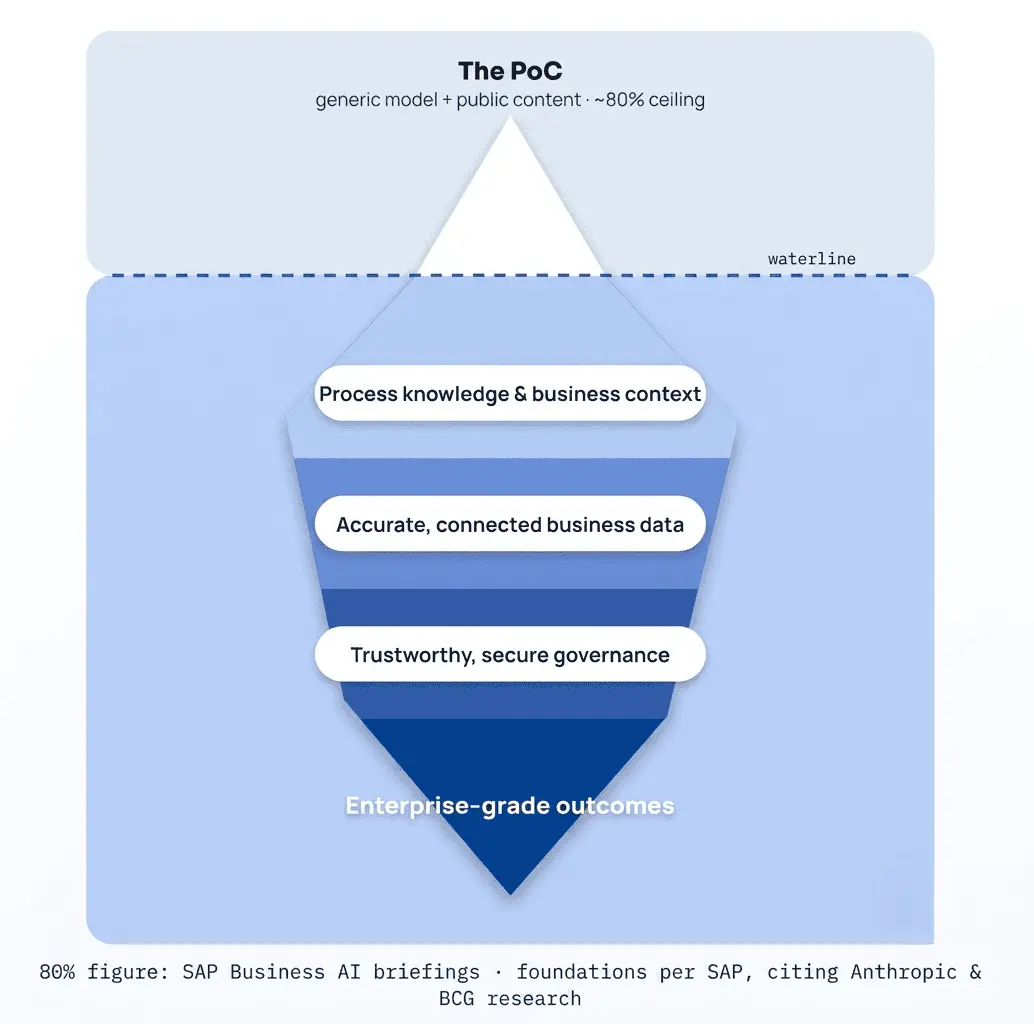
It’s what is below the waterline that will improve your bottom line
Seen an impressive AI demo, that’s the tip of the iceberg, and it tops out around 80% accuracy without your business context (the figure SAP itself uses in its Business AI briefings). Enterprise-grade outcomes live below the waterline: process knowledge and business context, accurate and connected business data, and trustworthy, secure governance.
This is why having embedded AI that knows your data, grounded in your ERP and permission aware, is a foundational model you should look to adopt if your ERP offers it.
What does AI in my ERP currently look like

What SAP ships natively: SAP’s Business AI strategy is anchored on Joule; role-aware, natural-language, grounded in your SAP data, live across 35 SAP solutions. SAP’s AI catalog for SAP Cloud ERP ↗ currently lists 47 ready-made AI features and agents, from finance agents to document AI and an SAP AI Agent Hub coordinating agents over the emerging A2A and MCP standards.
The new Joule structure, decoded: Joule is the front door. Joule Work is a stand-alone workspace for executing business-wide workflows across SAP and non-SAP systems. Joule Assistants coordinate agents with deep role and process context through smart teammates. Joule Agents are purpose-built for well-defined multi-step workflows. Joule Studio (2.0, Sapphire 2026) is where you build your own intent-based development, pro-code support, free design-time access through end of 2026. One honest note: SAP presents parts of this as a mix of current and visionary which tells you which pieces are live for your licence is part of our job.
Where we come in: Forty-seven catalog items doesn’t mean forty-seven relevant ones. The Base-vs-Premium split, AI-unit consumption, permissions and change management decide the value. For SAP Cloud ERP clients we shortlist, sequence and cost what genuinely fits and make the honest call on where Joule Studio, a custom build, or “wait” beats turning something on just because it’s in the catalog.
And SAP Business One. SAP’s AI investment is reaching Business One when the new web client opens the door to more native AI over time, and as SAP’s partner we’ll help you adopt it as it lands. Today, many Business One sites, especially on-premise and privately hosted want AI value sooner than the native roadmap delivers it. That’s the gap our advisory and the Levcore platform (in beta) are built to close: permission-aware agents over your live B1 data, with human-approved writes, while your upgrade path stays intact.

What Sage ships natively: Sage has moved fast across the whole finance cycle, not just chat. The Sage AI family now includes Close Automation (tracks close tasks, flags issues, guides month-end), AP Automation (draft bills created and matched automatically), Outlier Detection (unusual journals flagged in real time), Cash Prediction & Optimisation, Intelligent Time and Advanced Search. Recent releases added the Sage Intacct AI Gateway — REST APIs plus a native MCP server with role-based permissions preserved and AI-driven three-way matching at line level.
The headline act is the Finance Intelligence Agent: ask “which bills should I pay by the end of the month?” and it weighs cash on hand, payment terms, due dates and early-pay discounts, recommends the optimal set and shows its reasoning in a “How Copilot worked this out” view before guiding you to the pre-filtered Bills page to act.
Where we come in: we help you adopt the native tooling well and turn on what’s live for your region and edition, wire the AI Gateway and MCP server to Teams or Copilot safely before layering the niche agents that are specific to your business. So you don’t pay twice, and you don’t leave value on the table.

What MYOB Acumatica ships natively: an AI story built for ANZ from the ground up processed in local data centres and shaped around how Australian and New Zealand businesses actually work. MYOB frames it in three layers; AI Automation (does the work), AI Advisor (insights, anomaly detection, forecasting) and AI Assistant (interactive help) with the first features already in customers’ hands: AI-assisted AP Bill Entry (OCR plus semantic interpretation, by upload or a dedicated AP mailbox), Expense Management, Anomaly Detection on AP costs and sales-order margins, a Cross-Sell Assistant and intelligent Autocomplete.
The big move is AI Automations (technology preview, April 2026): build your own AI agents in plain language, embedded directly inside MYOB Acumatica and grounded in your own business data built with AWS and Anthropic, running Claude models via Amazon Bedrock. Think auto-generated stock item descriptions, case-note closure summaries, and multi-step agents that build and publish a whole “top five customers by sales” inquiry from a single sentence. Layered on top: the five-year MYOB–Microsoft partnership, with first jointly built features expected late 2026.
Where we come in: the risk runs both ways whether buying or building what the platform is about to ship, or turning features on without the fine print (expense capture is mobile-first today; anomaly detection needs enabling; AI Automations requires 25 R2 with usage-based commercials). We keep you current on the roadmap and the commercials, adopt what’s genuinely useful for Australian compliance work today (BAS, GST, PAYG), and identify the workflows worth a bespoke build now versus waiting. And a convergence worth noting: MYOB’s AI Automations runs on the same Anthropic model family and open standards our own platform work is built on.
Questions we get asked about AI in ERP
Is Joule included with SAP Cloud ERP, or does it cost extra?
Part of it is. Joule Base comes with a standard SAP Cloud ERP subscription and covers navigation, search and plain-language questions. Joule Premium is the paid tier. It adds the advanced transactional and analytical skills plus the role-based Joule agents, licensed by solution area and paid for through SAP AI Units. A sensible pattern is Base for everyone and Premium only for the people who use the advanced capability.
What AI is built into SAP Business One?
Native AI for SAP Business One is emerging through the new web client, and more will arrive as SAP builds it out. Many B1 sites, especially on-premise and privately hosted ones, want AI value sooner than the native roadmap can deliver it. For those sites we add permission-aware agents that work alongside the ERP, through our advisory practice and our Levcore platform, which is in beta.
What AI does Sage Intacct include?
The Sage Intacct AI family includes Close Automation, AP Automation, Outlier Detection, Cash Prediction and Optimisation, Intelligent Time and Advanced Search. The AI Gateway adds REST APIs and a native MCP server that preserves role-based permissions. The Finance Intelligence Agent is in early-adopter release, starting in the US, so we confirm which features are live for ANZ tenants before they shape your plan.
What AI does MYOB Acumatica include?
MYOB Acumatica has ANZ-hosted AI features in customers’ hands today: AI-assisted AP Bill Entry, Expense Management, Anomaly Detection, a Cross-Sell Assistant and intelligent Autocomplete, organised into Automation, Advisor and Assistant layers. AI Studio, in technology preview since April 2026, lets you build your own agents on Anthropic’s Claude models via AWS. It needs the 25 R2 release and has usage-based commercial terms.
Should we use our ERP's native AI or build custom agents?
Start with the native tooling. Vendor-shipped AI is permission-aware and maintained for you, and it is usually the best value. If it already does the job well, use it. Custom agents make sense where a high-value workflow is unique to how you operate. Our AI Value Workshop gives every candidate one of four calls: ride the native tooling, adopt and extend, build a custom agent, or not yet.
Is it safe to connect AI to our ERP data?
It can be, if the governance is designed in. The AI should act with each user’s own permissions, and data should stay in Australia where residency matters. Answers should be grounded in your live records, and your data should never be used to train models. Anything that writes needs human approval, and every action should be auditable. Our AI Governance page works through each of these checks.